

Recognition of screws
▶01. Screw production standards
GB-Chinese national standard (national standard) ANSI-American national standard (American standard)
DIN-German national standard (German standard) ASME-American Society of Mechanical Engineers standard
JIS-Japanese national standard (Japanese standard) BSW-British national standard
ISO-International Standard
▶02.Screw head type
Screw head thickness and diameter size can generally be customized, usually the head diameter than the screw unilateral larger than 0.6mm or more to cover the lock does not wear depending on too small will be easy to lock through. For example, M1.4 screws, screw head diameter of 2.6mm. plastic screw hole opening diameter of 1.6, unilateral coverage of 0.5mm. with different product designs, screw specifications become larger, the design parameters have changed, such as M3.0 screws, openings to be done to more than 3.5, then the diameter of the screw head should be done to more than 5.0 to be safe. Here is just a simple list, the design parameters to the actual product design requirements to define.
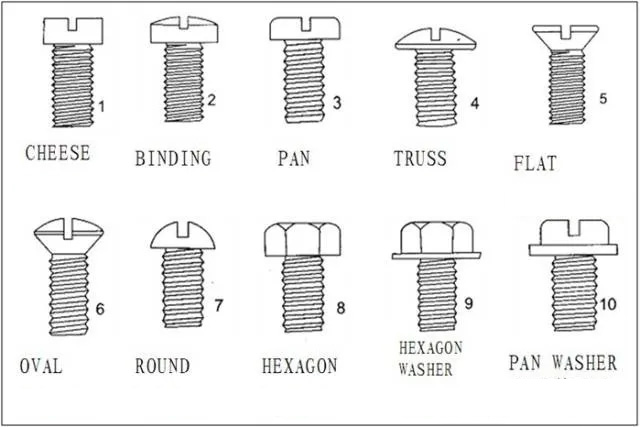
※Several head types of conventional screws
▶03.Slot type of screws
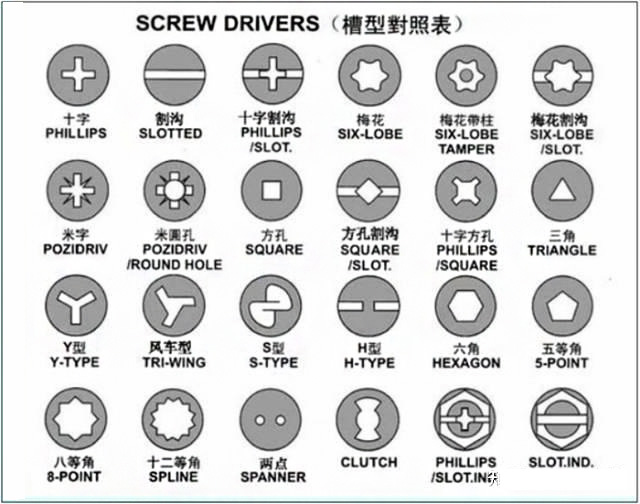
The slot type of the screw determines the shape of the head of the tool used for assembly and disassembly, and the conventional design tries to use a cross and a word. For details, see the following figure.
▶04.Material of screws
Materials are, low, medium and high carbon steel, brass, bronze, antimony copper, aluminum, alloy steel, stainless steel and so on.
Design commonly used for low-carbon steel and medium-carbon steel screws, high-end a little with stainless steel screws.
▶05. The surface treatment of screws
Due to different environments, the performance of the screws have different impacts. Screws after playing a long time will rust, then you need to do surface treatment to extend the service life. Detection of salt spray, corrosion resistance test needs to be 24H, as well as other testing requirements. Commonly used are the following types of surface treatment.
① black zinc plating
②Colorful zinc plating
③Blue zinc plating
④White zinc plating
⑤Black oxide + (painted)
⑥Nickel Plated
⑦Brass Plated
⑧Bronze Plated
There are also chrome plated, antique brass plated, antimony plated, dacron rust plated, etc. If you want to know what it looks like, search the internet yourself, and I'll just post about this many pictures here.
▶06.The types of screws
Currently on the market for electronic products commonly used screws have the following three types:
◆self-tapping screws
With pointed teeth, without threading with the guide, just force the lock to the guide hole to lock themselves together. (There are also 60-degree non-pointed teeth of the self-tapping screws) are commonly used in plastic products locking, without the need for repeated disassembly of the structure.
◆ machine screws
Threaded guide holes, self-locking with the nut; commonly used in the structure of the teeth guide, or with the nut locking, used in the structure can be repeatedly disassembled.
◆ Self-tapping self-drilling screws.
Head with self-drilling notch, without any guide hole, drilling and locking by itself. Commonly used in wood, carriages, plywood and other structures without screw hole guide.