

How brake caliper guide pins work
The brake caliper guide pin is an important part of the brake system, its role is to ensure that the brake caliper can accurately align the brake disc when braking, thus ensuring the effectiveness and safety of the brakes. Let's take a closer look at how brake caliper guide pins work.
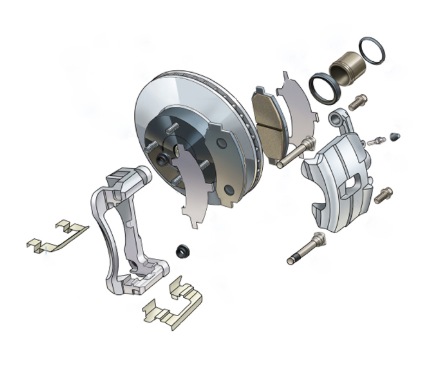
We need to understand the structure of the brake caliper. A brake caliper usually consists of two half shells with the brake disk sandwiched between them. When the brake pedal is pressed down, the brake hydraulic cylinder generates hydraulic pressure, which presses the brake pads against the brake disk, thus realizing braking. The role of the brake caliper guide pin is to ensure that the brake caliper can be accurately aligned with the brake disc when braking, thus ensuring the effectiveness and safety of braking.

The brake caliper guide pin usually consists of two parts: the guide pin and the guide sleeve. The guide pin is a long metal rod, one end of which is fixed to the brake caliper and the other end is inserted into the guide sleeve. The guide sleeve is a metal sleeve that is usually fixed in the wheel suspension system. The inside of the guide sleeve has a circular hole in which the guide pin slides freely.
When the brake pedal is depressed, the brake hydraulic cylinder generates hydraulic pressure that presses the brake pads against the brake disk. At this point, the brake caliper moves towards the brake disk and the guide pin moves with it. The purpose of the guide sleeve is to ensure that the guide pin can only move in one direction, thus ensuring that the brake caliper moves in the same direction as the brake disk.
The brake caliper guide pin is an important part of the brake system, and its role is to ensure that the brake caliper can be accurately aligned with the brake disc when braking, so as to ensure the effectiveness and safety of braking. Understanding the working principle of the brake caliper guide pin can help us better maintain and care for the brake system to ensure driving safety.
